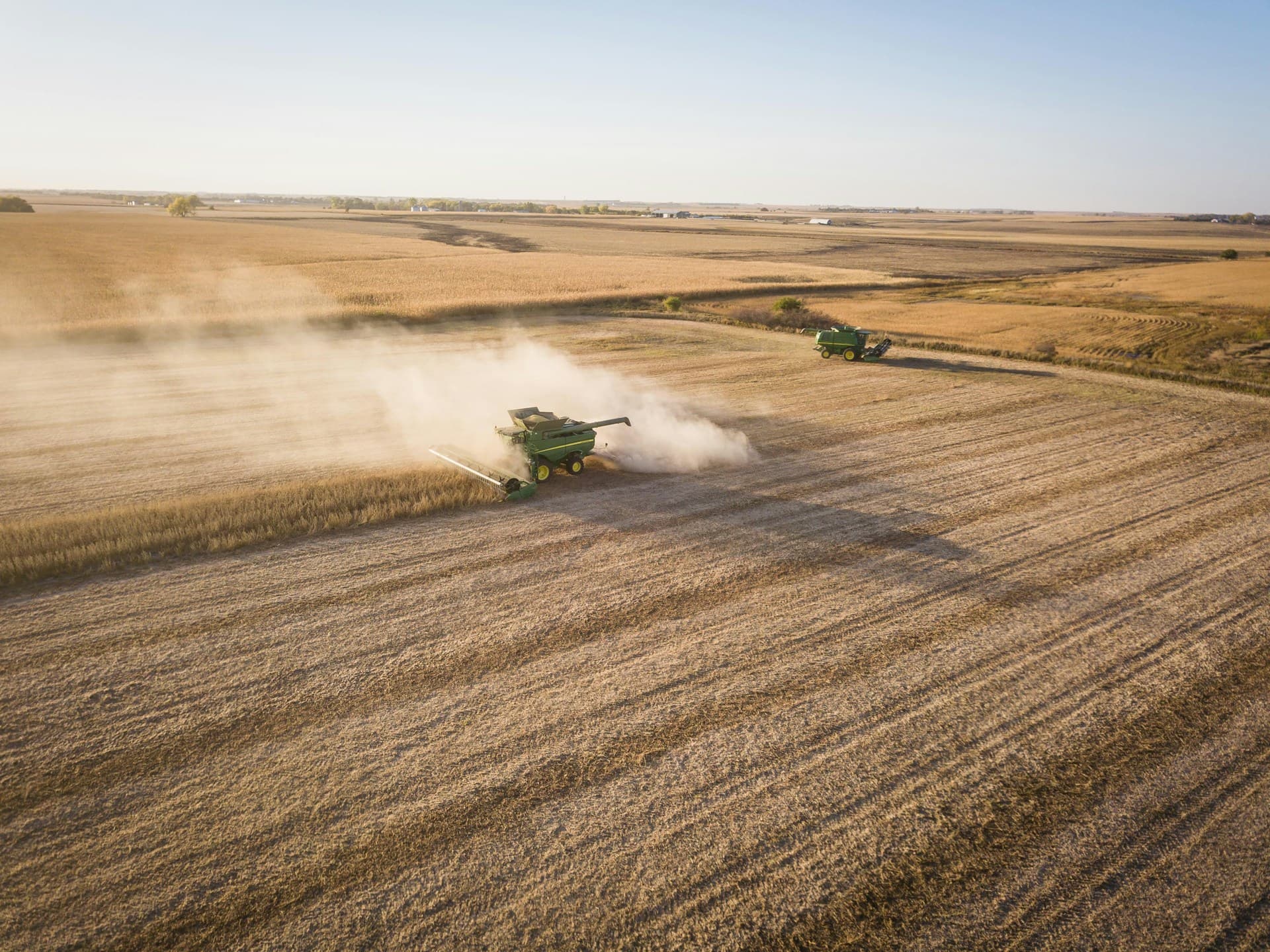
Aerial view of combine harvester working in a soy field
Soy · EUDR · 30 Dec 2026← EUDR overview

Soy exporters: EUDR compliance from South America to Europe

Every soy shipment entering the EU from 30 December 2026 requires a verified Due Diligence Statement in EUDR Information System — filed at the production farm level, not the grain elevator level. We extract your farm polygons, run the satellite verification, and file as your Article 6 authorized representative.

Why soy compliance is harder than it looks

Four pain points specific to soy supply chains

01

Mass balance breaks plot-level traceability

Soy from hundreds or thousands of farms is commingled at grain silos, river elevators, and export ports. EUDR requires per-plot verification for every tonne that enters the EU — not a mass-balance or segregation average. If your grain trader cannot tell you which farms contributed to your specific shipment, you cannot file a valid DDS.

02

Cerrado-origin and Pampas-origin mix at the exporter

EU buyers do not always know which biome their soy originated from. An exporter mixing Cerrado-frontier farms (high-risk) with Pampas farms (low-risk) in the same truck needs farm-by-farm verification across the entire supply base — not just the high-risk portion. EUDR applies to the entire DDS, not to a subset.

03

Brazil's CAR system is necessary — but not sufficient

Brazil's CAR gives you registered farm polygons. It does not give you a deforestation-free guarantee. Deforestation alerts within a CAR-registered perimeter after 31 December 2020 still require Sentinel-2 cross-validation and documented mitigation evidence. CAR registration plus EUDR verification are both required — one does not substitute the other.

04

One farm, two biomes — EUDR applies to the high-risk half

MATOPIBA properties often straddle a biome boundary: consolidated Cerrado on one side, an active deforestation frontier bordering Amazon or Caatinga on the other. EUDR verification runs per polygon, not per farm — a single CAR registration can contain both a compliant plot and one that fails the 31 Dec 2020 cutoff. Averaging risk across the whole property misses exactly the fraction the Regulation is built to catch.

Technical requirements for soy

What EUDR requires — specifically for soy

Farm-level geolocation

  • Farms <4 ha: a single GPS point at minimum 6 decimal places.
  • Farms ≥4 ha: a full GeoJSON polygon — required for almost all commercial soy farms.

Cutoff date: 31 December 2020

Soy must be produced on land that was not deforested after 31 December 2020. We verify every farm against Sentinel-2 imagery and GFW deforestation alerts from that date forward. A farm in the Cerrado showing vegetation loss after the cutoff requires documented evidence before a DDS can be filed.

HS codes for soy under EUDR

  • 1201 — Soybeans, whether or not broken
  • 1208.10 — Soya bean flour and meal
  • 2304 — Soya-bean oil-cake and other solid residues
  • 1507.10 — Crude soya-bean oil
  • 1507.90 — Other soya-bean oil and fractions

RTRS / ISCC certification reduces burden — but doesn't replace DDS

Roundtable on Responsible Soy (RTRS) and ISCC-certified soy have existing chain-of-custody frameworks that reduce the EUDR documentation workload. However, they do not substitute the legal obligation to file a DDS in EUDR Information System — deforestation-specific satellite verification is still required.

Country-by-country

Where you source — what that means for EUDR

South America — the primary soy-to-EU export corridors.

Brazil

High (Cerrado / Amazon)

Cerrado-origin soy (Mato Grosso, Bahia, MATOPIBA frontier) requires enhanced deforestation verification against the 31 Dec 2020 baseline. Amazon Legal origin (Pará, Rondônia) is highest risk. Brazil's CAR (Cadastro Ambiental Rural) system provides farm polygons — a critical asset for EUDR compliance when combined with Sentinel-2 cross-validation.

Main challenge: Cerrado and Amazon biome overlap with expanding soy frontier

Argentina

Standard (Gran Chaco exception)

Pampas-origin soy carries minimal deforestation risk — the biome was converted largely before the 31 Dec 2020 cutoff. However, Gran Chaco expansion in Salta, Chaco, and Santiago del Estero provinces requires additional verification. Most Argentinian exporters deal with Pampas-dominant supply chains that are relatively straightforward to document.

Main challenge: Gran Chaco frontier farms require enhanced verification

Paraguay

High

Among the highest soy-related deforestation risk jurisdictions in South America. Formal land registry is incomplete in many departments. Eastern Paraguay (Itapúa, Alto Paraná) has better documentation than the western Chaco expansion zones, where deforestation pressure is highest and GPS data is rarely available at the plot level.

Main challenge: Incomplete land registry and high deforestation pressure

Bolivia

High

The expanding soy frontier in Santa Cruz department overlaps with documented deforestation hotspots in the Chiquitano dry forest and Chaco ecosystems. Enhanced verification is required for all Bolivian-origin soy. ABT (Autoridad de Bosques y Tierra) records provide starting documentation, but independent satellite cross-validation is mandatory.

Main challenge: Santa Cruz soy expansion overlaps with deforestation hotspots

Uruguay

Standard

Small volumes relative to Brazil and Argentina, but growing. Uruguay's national cadaster (DIEA) is well-documented and land registry data is available at plot level. Minimal deforestation risk — the challenge is administrative: converting cadaster data into EUDR-compliant GeoJSON schema for EUDR Information System filing.

Main challenge: Low deforestation risk — challenge is data formatting only

What you receive

Complete soy EUDR package

  • CAR polygon extraction and validation (Brazil)
  • Per-farm deforestation verification (Sentinel-2 vs 31 Dec 2020)
  • Biome classification: Cerrado, Amazon, Pampas, Gran Chaco
  • Country risk tier assessment with mitigation evidence
  • Supplier-level risk scoring for your soy supply base
  • Article 10 due diligence narrative
  • DDS structured following EU Information System schema
  • EUDR Information System filing as your authorized representative (Art. 6)
  • Due Diligence Reference Number for EU customs
  • 5-year encrypted archive package

Typical scope — soy

  1. Eligibility Diagnostic

    3 days

    Biome classification, country risk tier, CAR coverage assessment, readiness scorecard.

  2. Due Diligence Statement

    3–6 weeks

    Full DDS per shipment — farm polygon extraction, Sentinel-2 verification, EUDR Information System filing.

  3. Monitoring

    Quarterly

    Seasonal deforestation alerts and annual DDS renewals for your verified supply base.

Talk to a specialist

Scoped proposal — typically in 48h

Other EUDR commodities

CoffeeCocoaTimberCattlePalm oil

Working with timber, cattle, or palm oil? Talk to Diego directly →

Know your EUDR exposure in 10 minutes

Free compliance check — commodity classification, country risk tier, farm polygon readiness. No account required.

No account required · PDF report by email · No commitment

EUDR for soy exporters — South America to Europe — Dexffo