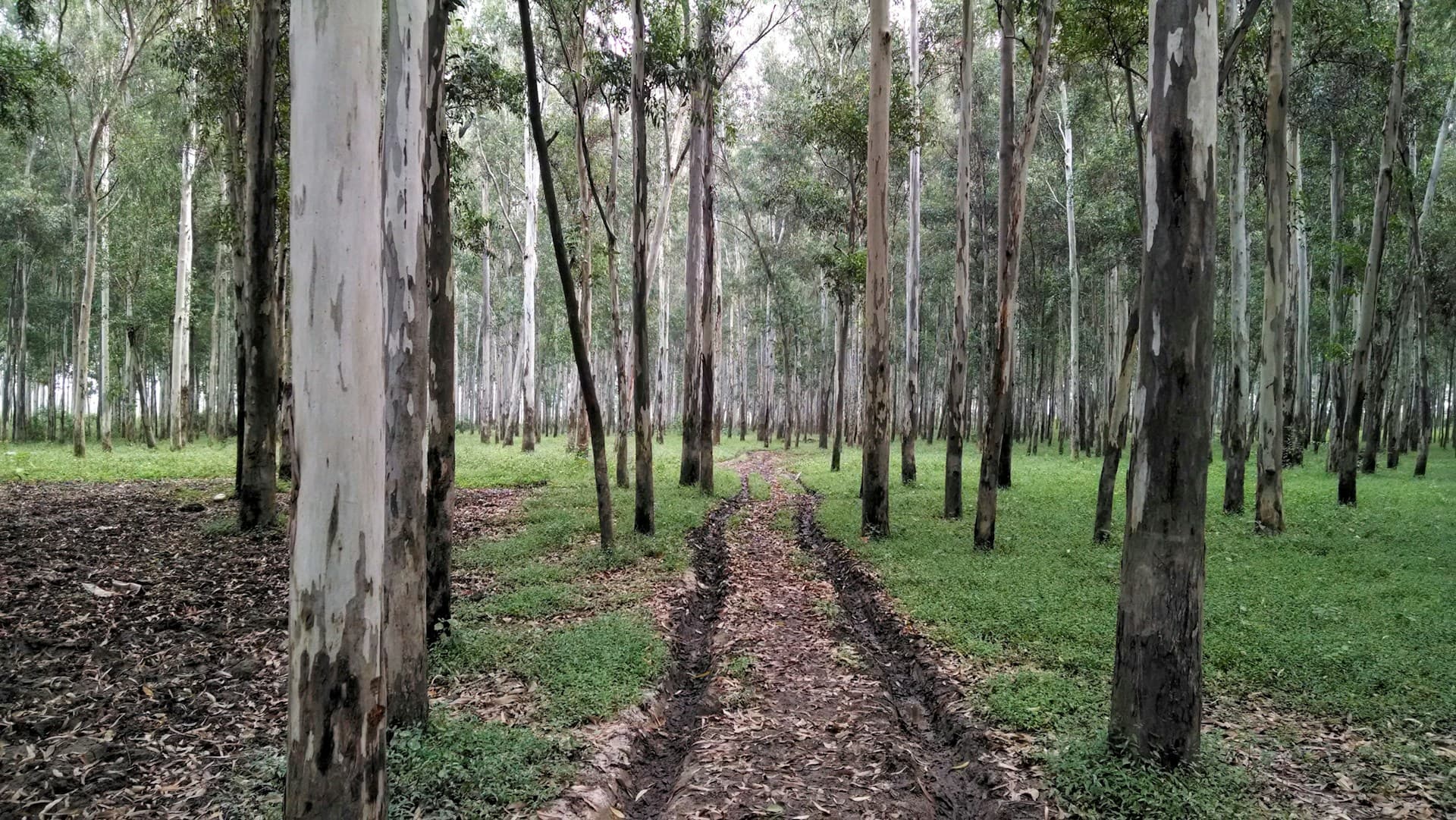
Forest path among mature eucalyptus trees in a managed plantation
Timber · EUDR · 30 Dec 2026← EUDR overview

Timber exporters: EUDR compliance from Latin America to Europe

Every timber shipment entering the EU from 30 December 2026 must carry a verified Due Diligence Statement in EUDR Information System — filed at the harvest-plot level, not the species level. We map your supply chain and file it for you as your Article 6 authorized representative.

Why timber compliance is harder than it looks

Four pain points specific to timber supply chains

01

Multi-step transformation hides the forest of origin

A wooden desk may contain timber from five different forests in three different countries. EUDR requires tracing every wood component in a finished product back to its harvest plot — with GPS coordinates and deforestation evidence for each. The longer the transformation chain, the harder this becomes.

02

Logs commingled at the sawmill break traceability

Most sawmills accept logs from multiple concessions and mix them in the log yard. Once mixed, physical segregation is expensive or impossible. EUDR compliance for timber requires either identity-preserved supply chains — or detailed harvest records that allow computational reconstruction of each shipment's origin.

03

CITES species require a parallel permit — not a substitute

Species such as big-leaf mahogany (Swietenia macrophylla), cedar (Cedrela odorata), and certain Dalbergia species are listed under CITES Appendix II. An EUDR Due Diligence Statement and a CITES export permit are both legally required — neither substitutes the other. Many exporters underestimate this dual obligation.

04

Volume data doesn't convert to plot-level origin automatically

Customs declarations use cubic metres or weight. EUDR compliance is anchored to GPS coordinates of the harvest plot. Converting from "X m³ of timber species Y" back to "harvest plots A, B, C with coordinates" requires harvest records — rarely maintained in machine-readable format by small producers or community forestry operations.

Technical requirements for timber

What EUDR requires — specifically for timber

Harvest-plot geolocation — same rules as all commodities

  • Plots <4 ha: a single GPS point (lat/lon, 6 decimal places) for the harvest area.
  • Plots ≥4 ha: a full GeoJSON polygon of the harvested area — not the entire concession boundary.

Cutoff date: 31 December 2020

Timber must come from land that was not deforested after 31 December 2020. We verify every harvest plot against Sentinel-2 tree cover loss imagery and Global Forest Watch data from that date forward. Any forest canopy change within the harvest area after the cutoff requires documented mitigation evidence before a DDS can be filed.

HS codes for timber under EUDR

  • 4403 — Wood in the rough (logs)
  • 4407 — Wood sawn or chipped lengthwise
  • 4408 — Veneer sheets
  • 4412 — Plywood and laminated wood
  • 4418 — Builders' joinery and carpentry
  • 4706 — Pulps of wood or fibrous cellulosic material
  • 9401/9403 — Furniture with wood components

FSC / PEFC certifications reduce burden — but don't replace DDS

Forest certification schemes (FSC, PEFC) provide chain-of-custody documentation that significantly reduces the EUDR verification workload. However, they do not substitute the legal requirement to file a DDS in EUDR Information System. A certified supply chain still needs an authorized representative to file on your behalf.

Country-by-country

Where you source — what that means for EUDR

Latin America — the primary LATAM timber-to-EU corridors.

Brazil

High (Amazon)

Amazon biome overlap with commercial timber concessions is the primary risk. The Brazilian Forest Code (Código Florestal) requires Área de Reserva Legal documentation, but EUDR requires individual harvest-plot-level verification. Commercial eucalyptus and pine plantations in Paraná and Santa Catarina are generally lower-risk plantation origin.

Main challenge: Amazon deforestation overlap requires enhanced satellite verification

Bolivia

High

Among the highest deforestation-risk jurisdictions for timber in South America. Concession management plans (POAs — Planes Operativos Anuales) exist on paper, but field verification is inconsistent. ABT (Autoridad de Bosques y Tierra) records provide a starting point — but independent Sentinel-2 cross-validation is required for every shipment.

Main challenge: Concession records exist but field verification is weak

Peru

Standard

Complex but manageable. Forest concessions with SERFOR-approved annual operating plans (POAs) provide documentation anchors. Artisanal and community-managed timber typically has weaker chain-of-custody records. DRC-certified operations have a significant head start on EUDR compliance.

Main challenge: Artisanal timber lacks chain-of-custody documentation

Colombia

Standard

Smaller timber export volumes than Brazil or Peru. Pacific coast and Amazon-origin timber requires regional environmental authority (CARs) permits that partially document forest of origin. The challenge is converting permit-level data into EUDR-compliant plot-level GPS coordinates with deforestation evidence.

Main challenge: CAR permits document approvals — not GPS coordinates

Mexico

Standard

Pine and oak timber from Oaxaca, Chihuahua, and Durango. Community-managed (ejido) forestry models with documented harvest areas (Programas de Manejo Forestal) are a strong starting point. Ejido boundaries are GPS-mapped and often registered with the SEMARNAT forest registry — solid documentation base for EUDR.

Main challenge: Converting ejido forest management plans to EUDR plot schema

Ecuador

Standard

Balsa wood — used in wind turbine cores and aerospace applications — is Ecuador's primary timber export. Plantation-grown balsa in Los Ríos and Guayas provinces carries lower deforestation risk than native forest timber. Balsa concession maps are generally available; the challenge is formatting them into EU Information System-compliant GeoJSON.

Main challenge: Formatting balsa plantation data into EUDR GeoJSON schema

What you receive

Complete timber EUDR package

  • Species identification and HS code classification per product component
  • Chain-of-custody mapping from harvest plot to export container
  • Per-plot deforestation verification (Sentinel-2 vs 31 Dec 2020)
  • CITES species flag and parallel permit documentation guidance
  • Country risk tier assessment with mitigation evidence
  • Article 10 due diligence narrative
  • DDS structured following EU Information System schema
  • EUDR Information System filing as your authorized representative (Art. 6)
  • Due Diligence Reference Number for EU customs
  • 5-year encrypted archive package

Typical scope — timber

  1. Eligibility Diagnostic

    3 days

    Operator/trader classification, country risk tier, HS code review, readiness scorecard.

  2. Due Diligence Statement

    4–8 weeks

    Multi-origin timber DDS — more complex than single-commodity shipments due to chain-of-custody depth.

  3. Monitoring

    Quarterly

    Annual DDS renewals and seasonal deforestation alerts for active concessions.

Talk to a specialist

Scoped proposal — typically in 48h

Other EUDR commodities

CoffeeCocoaSoyCattlePalm oil

Working with soy, cattle, or palm oil? Talk to Diego directly →

Know your EUDR exposure in 10 minutes

Free compliance check — commodity classification, country risk tier, chain-of-custody readiness. No account required.

No account required · PDF report by email · No commitment

EUDR for timber exporters — Latin America to Europe — Dexffo